

EVIDENCE-BASED TREATMENT FOR OCD
OCD Can Make You Doubt Everything.
Your thoughts. Your memories. Your intentions. Your relationships. Your faith. Even yourself.
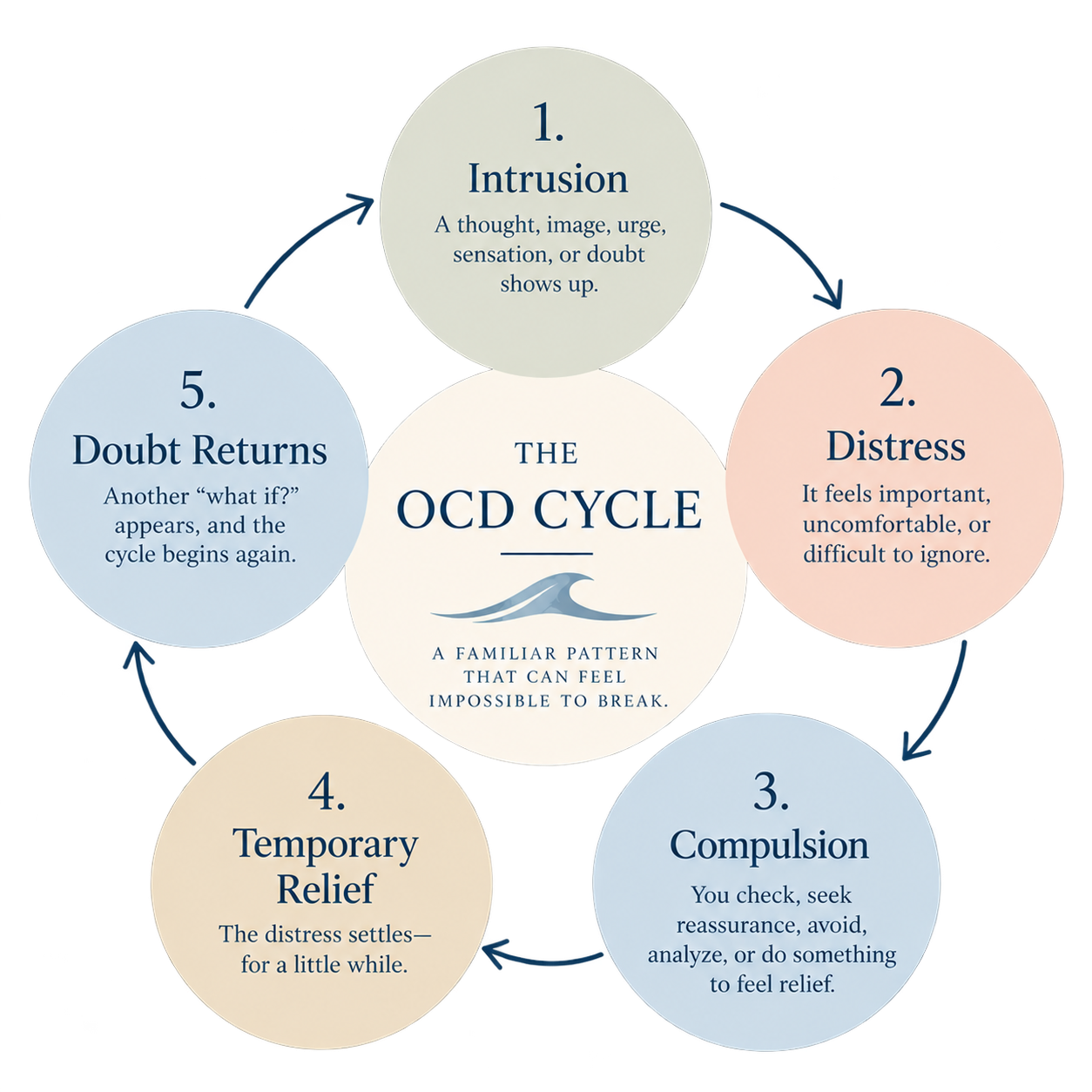
OCD can start with almost anything—a thought you hate having, an image you can’t get out of your head, an urge you just can’t shake, a sensation you suddenly can’t stop noticing, or a memory you no longer trust.
You know it might be irrational, but it still feels important enough that you can’t just ignore it.
So you check. You replay. You search. You ask. You confess. You analyze. You avoid. You try to figure it out until you finally feel certain enough to move on.
For a little while, you feel better.
But then the doubt comes back: “What if…?”
Treatment can help you break that cycle.

OCD is Bigger than Stereotypes
OCD is about much more than cleanliness or organization. It can involve intrusive thoughts, images, urges, sensations, doubts, or memories related to harm, relationships, religion or morality, identity, health, responsibility, perfectionism, or feeling “just right.”
Compulsions are not always visible. They can happen internally through rumination, mental checking, reviewing, reassurance seeking, confessing, researching, or analyzing what something “really means.”
That’s one reason OCD can go misunderstood or unnoticed for years.

Treatment In Action
Exposure and Response Prevention (ERP) is the gold-standard treatment for OCD. ERP helps clients gradually face uncertainty while reducing compulsions, focusing not on eliminating intrusive thoughts or achieving certainty, but on changing how they respond to fear and doubt.
01- Recognize the Pattern
Identify the fears, doubts, and triggers that set OCD in motion—and the compulsions that keep the cycle going.
02- Approach the Uncertainty
Gradually practice facing feared thoughts, situations, sensations, or uncertainty instead of avoiding or solving them.
03- Change the Response
Practice allowing the urge to be there without automatically responding with a compulsion.
04- Learn Through Experience
Discover that anxiety and uncertainty can be present without needing to be solved—and that life can continue anyway.
More Than One Way Forward

ERP remains the foundation of OCD treatment, while elements of Acceptance and Commitment Therapy (ACT) and Inference-Based Cognitive Behavioral Therapy (I-CBT) may also be integrated to support the work.
Acceptance & Commitment Therapy (ACT)

ACT helps shift the focus away from trying to eliminate uncomfortable thoughts and feelings. Instead, clients practice allowing uncertainty to be present while choosing actions guided by their values and the life they want to live.
Inference-Based Cognitive Behavioral Therapy (I-CBT)
I-CBT focuses on how obsessional doubt gets created. Clients learn to recognize when OCD has moved away from what is actually known and into imagined possibilities—and practice trusting information grounded in the present.
OCD Treatment for Children & Teens

ERP with children and teens is adapted to age, developmental level, and individual needs. Treatment may incorporate play, movement, games, visual tools, and creative exposures to help young clients understand OCD and practice responding differently.
Parents may also be involved, particularly when reassurance, accommodation, or avoidance has become part of the OCD cycle. Parent guidance focuses on supporting progress without unintentionally reinforcing OCD.
For younger children, treatment often looks less like sitting and talking—and more like doing, practicing, and building confidence in real time.

Exposure Beyond OCD
Exposure-based treatment can help with more than OCD. Clients gradually practice facing feared situations and sensations while reducing avoidance and reassurance.
It may support treatment for:
Phobias
Health Anxiety
Emetophobia
School Avoidance
Panic & Interoceptive Fears
Social Anxiety
Treatment is tailored to each client’s needs and goals.

OCD can take up a lot of time and energy. Treatment can help you spend less of it responding to fear and more of it on the people, choices, and experiences that matter to you.